Men lose testosterone at approximately 1% per year from age 30. They also lose muscle mass, sleep quality, and recovery capacity. The standard advice — exercise more, sleep more, eat better — is correct but incomplete. The missing piece is almost always mineral depletion, specifically zinc and magnesium: the two minerals most rapidly depleted by physical training, stress, and poor sleep, and the two most directly linked to testosterone production.
Table of Contents
- The Testosterone-Mineral Connection
- Shilajit and ATP: How It Actually Boosts Energy
- Workout Recovery and Lactic Acid Clearance
- Zinc, Immune Function, and Why Most Zinc Supplements Fail
- Shilajit and Cognitive Performance in Men
- How to Take Shilajit for Best Results
- Frequently Asked Question.
The Testosterone-Mineral Connection
Testosterone is synthesised in the Leydig cells of the testes. This process requires zinc as a direct cofactor. Without adequate zinc, the enzymatic pathway that converts cholesterol into testosterone is impaired — not stopped, but significantly reduced. Studies consistently show an inverse relationship between zinc status and testosterone decline.
The problem is not that men are not taking zinc. It is that most zinc supplements are zinc oxide, which has an absorption rate of approximately 18–22% in healthy adults. The rest passes through unabsorbed. Ionic zinc, delivered via fulvic acid as found in Shilajit, crosses the gut wall at fundamentally different rates because fulvic acid acts as a transport chelate — it binds to the mineral and carries it actively through the intestinal membrane.
Clinical Evidence A peer-reviewed clinical trial (PMID 30850811) demonstrated that purified Shilajit supplementation in healthy male volunteers produced statistically significant increases in total testosterone, free testosterone, and DHEAS levels compared to placebo. The mechanism is mineral-mediated — not hormonal stimulation. |
Shilajit and ATP: How It Actually Boosts Energy
When people say Shilajit gives them energy, they do not mean it stimulates them the way caffeine does. They mean they feel less of the chronic low-grade fatigue that becomes normal in the thirties and forties. The mechanism is mitochondrial.
Mitochondria produce ATP (adenosine triphosphate) — the molecule cells use as fuel. This process requires magnesium (to stabilise the ATP molecule), iron (in the electron transport chain), and CoQ10 (as an electron carrier). Shilajit contains all three in bioavailable form and has been shown in clinical studies to increase mitochondrial activity directly.
The Real Meaning of ‘More Energy’ Caffeine blocks adenosine — the molecule that tells your brain you are tired. It does not produce energy; it masks the depletion signal. Shilajit does the opposite: it supplies the raw materials your mitochondria need to produce more ATP. The energy you feel is real cellular output, not borrowed time. |
Workout Recovery and Lactic Acid Clearance
Post-workout muscle soreness has two primary causes: micro-tears in muscle fibre (which heal and produce strength gains) and lactic acid accumulation (which causes the burning sensation and delayed soreness). Recovery is the process of clearing lactic acid, repairing muscle fibre, and restoring mineral balance.
Strenuous exercise depletes magnesium significantly. A single intense workout can deplete 10–20% of intracellular magnesium stores. Without replenishment, the next session begins at a deficit — recovery is slower, performance is lower, and injury risk increases.
Shilajit has been studied for its effect on exercise recovery. One clinical study found that subjects taking Shilajit showed significantly less exercise-induced muscle damage (measured by creatine kinase levels) and faster recovery of maximal force compared to placebo. The mineral replenishment mechanism explains both findings.
Zinc, Immune Function, and Why Most Zinc Supplements Fail
Zinc drives T-cell production. T-cells are the white blood cells responsible for identifying and destroying pathogens. When zinc is low, T-cell count falls, and immune response is slower. Men who train hard are at particularly high risk of zinc depletion because intense exercise burns through zinc rapidly.
The standard answer — take a zinc supplement — is undermined by the absorption problem described above. Zinc oxide supplements (the dominant form in supermarket supplements) are cheap to manufacture but biologically marginal. Ionic zinc via fulvic acid transport is not a marketing claim; it is a documented difference in the mechanism of intestinal absorption.
Shilajit and Cognitive Performance in Men
Brain fog, difficulty concentrating, and reduced motivation are increasingly common complaints in men over 35. These are not simply stress symptoms — they are often the downstream result of mineral depletion and mitochondrial underperformance in the brain.
The brain consumes approximately 20% of the body’s total ATP production despite representing only 2% of its mass. It is the most metabolically expensive organ in the body, and when ATP production is compromised by mineral deficiency, cognitive performance is among the first things to decline.
Iron, specifically, is essential for dopamine synthesis. Dopamine drives motivation, focus, and executive function. Low iron is clinically linked to reduced attention and motivation in adults, independent of anaemia.
How to Take Shilajit for Best Results
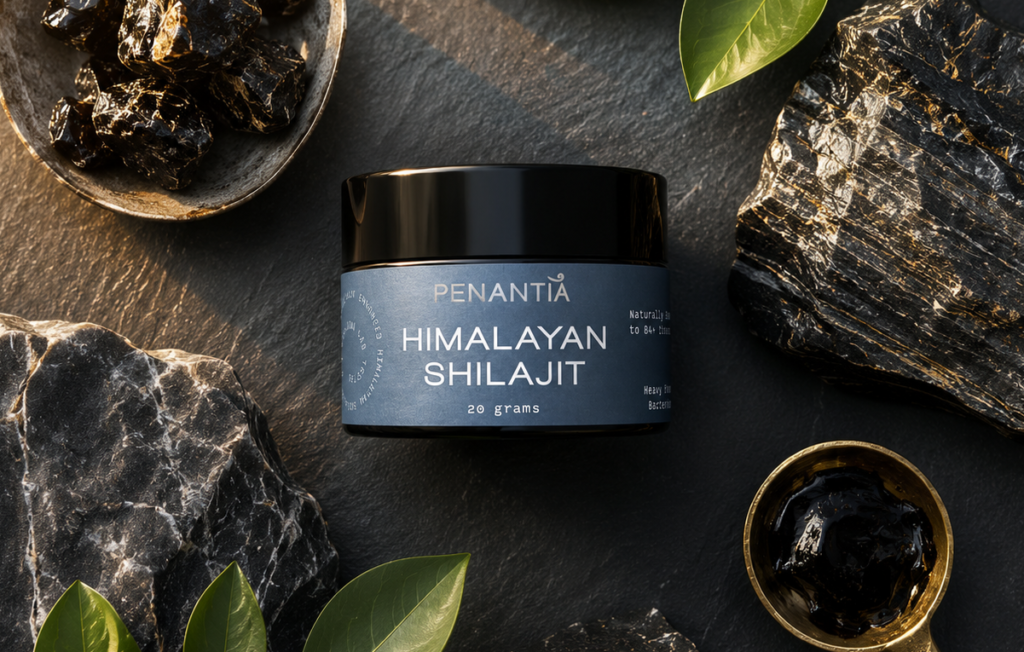
300 mg (pea-sized) of Penantia Shilajit Resin dissolved in warm water, first thing in the morning on an empty stomach. Consistent daily use for 30–60 days produces the most significant changes to testosterone markers, energy, and recovery in men.
- Do not mix with caffeinated drinks — this reduces mineral absorption
- Warm water (not boiling) dissolves the resin most effectively
- Training athletes may benefit from a second dose post-workout for recovery
- Combine with resistance training for best testosterone outcomes
Frequently Asked Questions
Does Shilajit increase testosterone directly?
Shilajit supports the mineral conditions required for testosterone synthesis — primarily through ionic zinc and the HPA axis regulation (via its adaptogenic properties). Clinical studies show statistically significant testosterone increases in healthy men taking purified Shilajit. It is not a pharmaceutical; it is a mineral delivery system that removes the nutritional bottleneck on natural testosterone production.
How long before I notice results?
Energy improvements are typically felt within 1–2 weeks. Recovery improvements within 2–3 weeks of consistent training alongside Shilajit. Testosterone marker changes (if measured via blood test) are typically observable at the 8–12 week mark.
Shop Penantia Shilajit Pure Himalayan Shilajit Resin — hand-harvested, Triphala-purified, batch-tested. Buy now from Penantia |