
Sleep Deprivation Symptoms: What Poor Sleep Is Actually Doing to Your Body and What to Do About It
The answer is not that your body is tired in a general sense. Each symptom on the list below has...
Read Article
You are exhausted. Your body is heavy with it. And you still cannot sleep.
You have probably tried the obvious things. Going to bed at a consistent time. Cutting caffeine. Putting your phone down an hour before bed. Maybe melatonin. Some of these helped a little or for a while. None of them fixed it.
The reason they did not fix it is that none of them address what is actually keeping you awake. The system that should be shifting your nervous system from alert to calm is either not receiving the signal, not having the mineral resources to act on it, or actively being overridden by a cortisol pattern that was built over months and does not switch off because you decided it is bedtime.
Here is what is happening and what changes it.
BEFORE YOU READ FURTHER This post covers the cortisol dysregulation and magnesium depletion pattern behind the tired-but-awake experience. These are among the most common mechanisms behind stress-related sleeplessness in otherwise healthy people. Several conditions can produce this same symptom pattern and require clinical assessment before a self-directed approach is appropriate: sleep apnoea, which is frequently undiagnosed and produces exactly this tired-but-unrefreshed pattern; thyroid dysfunction; medications and stimulants including caffeine, some antidepressants, and corticosteroids; mood disorders including bipolar spectrum conditions; and alcohol-related sleep disruption. If any of these apply or if you are unsure, please see a GP first. If you are generally healthy, have been sleeping poorly for weeks or months particularly during or after a stressful period, and have noticed that standard sleep hygiene advice helps minimally, this post is written for your pattern. |
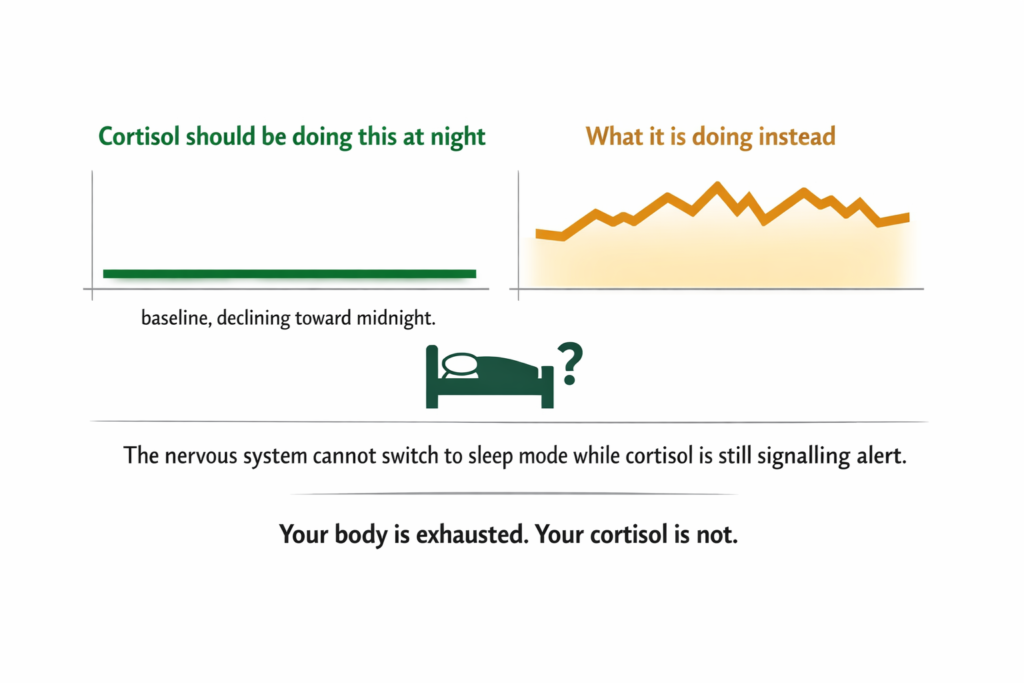
Cortisol follows a daily rhythm. It should peak in the morning to get you going and gradually decline through the day, reaching its lowest point around midnight so your nervous system can shift into sleep mode.
In people with chronic stress, that decline does not happen cleanly. Cortisol tends to stay elevated into the evening. The nervous system is still receiving an alert signal. Your body is physically exhausted from using its energy reserves all day. But the hormonal environment is still saying: stay awake, stay ready.
Sustained stress is the most common driver of this pattern, but it is not the only one. Evening light exposure from screens and bright indoor lighting delays the brain’s transition out of daytime mode, keeping cortisol and alertness elevated even when physical tiredness is high. Behavioural conditioning, the habit of using the bedroom for stimulating activity, and irregular sleep timing can produce a similar effect through a different pathway. Identifying which is dominant in your situation shapes which changes have the most impact.
This is not insomnia in the classical sense. It is the alerting system still running when it should have stood down. The exhaustion is real. The sustained activation is also real. Which is why lying down and trying to will yourself to sleep does not reliably work.
DEFINITION CORTISOL DIURNAL RHYTHM Cortisol naturally follows a 24-hour pattern: highest in the early morning to support waking and daily function, declining through the afternoon and evening, reaching its lowest point around midnight. This evening decline supports the nervous system’s shift from the alert state toward the calm state that sleep requires. Under sustained stress, this decline can be disrupted. Cortisol may remain elevated into the evening, contributing to difficulty settling. Sleep hygiene practices can support but do not always fully restore this rhythm when sustained stress is the driver. Evening light exposure can independently produce a similar disruption through a different pathway. |
WHAT TO DO ABOUT IT The cortisol evening elevation pattern responds to a combination of stress reduction, circadian support, and in many cases adaptogenic support. Reducing evening light exposure, establishing consistent sleep and wake times, and addressing the primary stress driver are the foundational steps. Ashwagandha has evidence from randomised trials for reducing perceived stress and supporting cortisol patterns in stressed adults. It is one option alongside general stress reduction approaches. Meaningful effect typically develops over four to eight weeks of consistent use. |
DOES THIS APPLY TO YOU? If you feel alert and mentally active at night but genuinely tired and sluggish through the day, the evening cortisol elevation pattern describes your situation specifically. If you feel equally tired at all hours regardless of time of day, or if sleep disruption has a different quality such as falling asleep easily but waking repeatedly, the mechanism may be different and our post on why you wake up at 3am covers that specific pattern. |
The elevated cortisol is one part of the picture. The missing mineral is the other. They are related and they compound each other.
GABA is the nervous system’s off switch. When you lie down at night, GABA is what produces the progressive calming that allows sleep to begin. It quietens neuronal firing, relaxes muscle tension, and shifts the brain from active processing toward the slow wave activity of sleep.
Magnesium supports GABA function. It acts as a cofactor at the GABA receptor. When magnesium is insufficient, GABA’s inhibitory action may be reduced, and the nervous system can remain more reactive than usual even when you are trying to be still and quiet. Thoughts keep coming. The body does not fully settle. Sleep onset is slower or more difficult.
Chronic stress depletes magnesium with every activation. Cortisol burns through it. Over weeks and months of sustained stress, the cellular magnesium reserves drop below the level needed for GABA to function well. This is why the tiredness does not translate into sleep. The exhaustion is genuine. The calming mechanism is broken because it is running out of the one thing it needs to work.
The full mechanism of how overnight magnesium depletion disrupts sleep is covered in our post on magnesium glycinate for sleep and why the form determines whether it actually works.
WHAT TO DO ABOUT IT Restoring magnesium through more bioavailable forms is the practical step here. A divided-dose approach, taking magnesium in the morning and a smaller dose before bed, is one standard approach supported by the evidence on magnesium and sleep. The morning sipping protocol using ionic magnesium dissolved in warm water is one way to achieve this; standard divided-dose magnesium glycinate or citrate capsules are another. Both aim to build a higher baseline throughout the day. Two to three weeks of consistent use and many people with this pattern report a shift: not a sudden crash into sleep but a gradual quietening at bedtime. |
DOES THIS APPLY TO YOU? If you have taken standard magnesium supplements and noticed limited change, the form is a likely factor. Magnesium oxide, the most common form in budget supplements and multivitamins, has low absorption compared to more bioavailable forms such as magnesium glycinate, citrate, or ionic magnesium. A form with higher bioavailability is more likely to restore cellular magnesium levels meaningfully. The compound is right. The delivery may have been the limiting factor. |
For some people the tiredness-without-sleep pattern has a third layer: anxiety that arrives specifically at bedtime or during the night. That is the same mechanism expressing differently and it has a slightly different entry point.
Some people describe the sleeplessness as physical: the body just will not settle. Others describe it as mental: thoughts that activate the moment they lie down, or a low-level anxiety that appears specifically at bedtime and was not present through the day.
Night time anxiety has the same root mechanism. Depleted GABA function reduces the nervous system’s capacity to inhibit thought and lower arousal. Cortisol elevation in the evening keeps the threat-assessment centres of the brain active. When you lie down and remove external distractions, those activated systems have nothing to process except whatever thoughts are available. The thoughts are not the problem. The neurological state generating them is.
This is why telling yourself the thoughts are not important or trying to think about something else does not consistently work. You are trying to use the conscious mind to override a system that is operating below the conscious level. The calming has to happen at the neurological level, through the GABA mechanism, not through the cognitive level.
Breathwork with an extended exhale, four counts in and six to eight counts out, activates the vagus nerve and shifts the autonomic balance toward parasympathetic dominance directly. This is not a distraction technique. It is a physiological intervention. Do it for five minutes lying down before sleep. Combine it with ionic magnesium dissolved in warm water sipped before bed. These two together address both the physiological and the mineral side of the nighttime anxiety pattern simultaneously.
The full GABA and magnesium mechanism behind anxiety, and why the same depletion produces daytime anxiety and night time sleeplessness through the same pathway, is covered in our post on magnesium glycinate for anxiety and why the form matters.
WHAT TO DO ABOUT IT For the anxiety-driven sleeplessness pattern: a more bioavailable magnesium form such as glycinate or citrate 30 to 60 minutes before bed supports GABA function from the mineral side. Extended-exhale breathing, four counts in and six to eight counts out for five minutes while lying down, is a well-evidenced technique for shifting the autonomic state toward calm through vagal activation. Removing screens 30 minutes before bed and consistent wind-down routines address the circadian and conditioning layer. These approaches work at different speeds and in combination are more effective than any single intervention alone. |
DOES THIS APPLY TO YOU? If anxiety appears specifically at bedtime and is not present through the day, the GABA depletion pattern combined with the removal of daytime distractions describes your situation. If anxiety is present consistently throughout the day and nig, the daytime pattern is worth addressing first and the magnesium anxiety post covers that specifically. If anxiety at night is severe, includes panic attacks or racing heart, or has been present for more than a few months, GP assessment is the appropriate first step. |
Sleep hygiene is not wrong. The issue is that it is often insufficient on its own when the cortisol and magnesium layer is also active.
Consistent bedtime: supports circadian anchoring and is a genuinely useful foundation. Insufficient on its own when evening cortisol elevation is sustaining the alert state.
No screens before bed: reduces blue light and stimulating content, both of which delay the circadian shift. More impactful than often credited, particularly when light exposure is a primary driver. Insufficient when mineral depletion is also present.
Melatonin: signals sleep timing and may help with sleep onset. Does not directly address GABA function or cortisol patterns. This is why melatonin sometimes produces drowsiness but not the settled quality of sleep.
Cutting caffeine: removes a stimulant and reduces adenosine interference. A supportive step. Insufficient when cortisol elevation is the primary driver.
The pattern these approaches share: they address real inputs but leave the mineral depletion and cortisol timing layer unaddressed. Combining sleep hygiene with magnesium restoration and stress management addresses more of the mechanism simultaneously.
Standard Thinking | The Biological Reality |
|---|---|
You just need better sleep hygiene | Sleep hygiene addresses circadian anchoring. It does not restore magnesium at the GABA receptor or reduce evening cortisol elevation. Both of those require different interventions |
Melatonin will help you sleep | Melatonin signals sleep timing. It does not produce the calming required for sleep onset when GABA function is impaired by magnesium depletion. This is why melatonin often makes you drowsy but you still cannot settle |
If you are tired enough you will eventually sleep | Cortisol elevation overrides the sleep drive. You can be genuinely exhausted and still have cortisol keeping the nervous system alert. Tiredness and the ability to sleep are governed by different systems that can be simultaneously in conflict |
Anxiety before bed is a thinking problem | Night time anxiety is a neurological state produced by depleted GABA function and active cortisol elevation. It is operating below the conscious level. Cognitive techniques help manage the symptoms. Restoring the GABA mechanism addresses the cause |
Being tired and being able to sleep are governed by two different systems that can conflict. The sleep drive accumulates from wakefulness and makes you physically tired. The ability to sleep requires the nervous system to shift from alert to calm, which depends on cortisol declining and GABA receptor function being adequate. When cortisol is chronically elevated from sustained stress, it keeps the nervous system in an alert state regardless of physical exhaustion. When magnesium is depleted, GABA cannot produce the calming required for sleep onset. Both can be true simultaneously, producing the exhausted-but-awake experience.
Night time anxiety has a specific biological mechanism rather than being simply worse worry. In the evening and night, cortisol should be declining to allow the nervous system to shift toward calm. When cortisol remains elevated from chronic stress, the threat-assessment systems of the brain stay active. When you lie down and remove external distractions, those active systems have nothing to process except whatever thoughts are present. Depleted GABA function from magnesium depletion simultaneously reduces the nervous system’s capacity to inhibit that activation. The thoughts feel more significant and more urgent than they would in a better-resourced neurological state.
Yes, through the GABA receptor mechanism. Magnesium is an essential cofactor at GABA receptors. Without adequate magnesium, GABA cannot engage the receptor effectively and the nervous system stays electrically reactive even at rest. The form matters significantly: magnesium oxide at 4 percent absorption does not meaningfully restore intracellular magnesium. Ionic magnesium at 85 to 95 percent absorption reaches the cellular level where the GABA receptor operates. The morning sipping protocol, which builds cellular magnesium throughout the day, is more effective than a single bedtime dose alone because it raises the overall baseline rather than just adding a small evening top-up.
Melatonin signals sleep timing, not sleep onset quality. It tells your biological clock that it is time to sleep. It does not produce the calming that allows sleep to begin when the nervous system is in an alert state from elevated cortisol and depleted GABA function. This is why melatonin often makes people feel drowsy or heavy-eyed but they still cannot settle or switch off. The timing signal is being received. The calming mechanism is not working because the mineral and hormonal prerequisites for it are not in place.
The timeline depends on which mechanism is primary. If magnesium depletion and GABA function are the primary issue, meaningful improvement in sleep onset and quality typically appears within two to three weeks of consistent ionic magnesium supplementation using the morning sipping protocol. If cortisol elevation is the primary issue, HPA axis restoration through ashwagandha takes four to eight weeks to produce the full effect on the evening cortisol decline. Most people with the combined pattern see initial improvement in two to three weeks and continue improving through six to eight weeks of consistent approach.
ONE MORE THING BEFORE YOU GO If your pattern is slightly different from what is described here, tell us in the comments. Tell us what you have already tried and what happened. We read every comment and respond with what the research says about your specific situation. If anxiety is the main thing stopping you from sleeping and you want to understand the specific mechanism behind that, we will point you to the most relevant post for your situation. |
Legal Disclaimer The information in this post reflects Penantia’s interpretation of available scientific research and is intended for educational purposes only. It does not constitute medical advice, diagnosis, or treatment. If you are experiencing persistent sleep disruption or significant anxiety, consult a qualified healthcare provider.

Never Miss any Updates From Blog!Never Miss any Updates From Blog!Never Miss any Updates From Blog!Never Miss any Updates From Blog!
Never Miss any Updates From Blog!




No products in the cart.