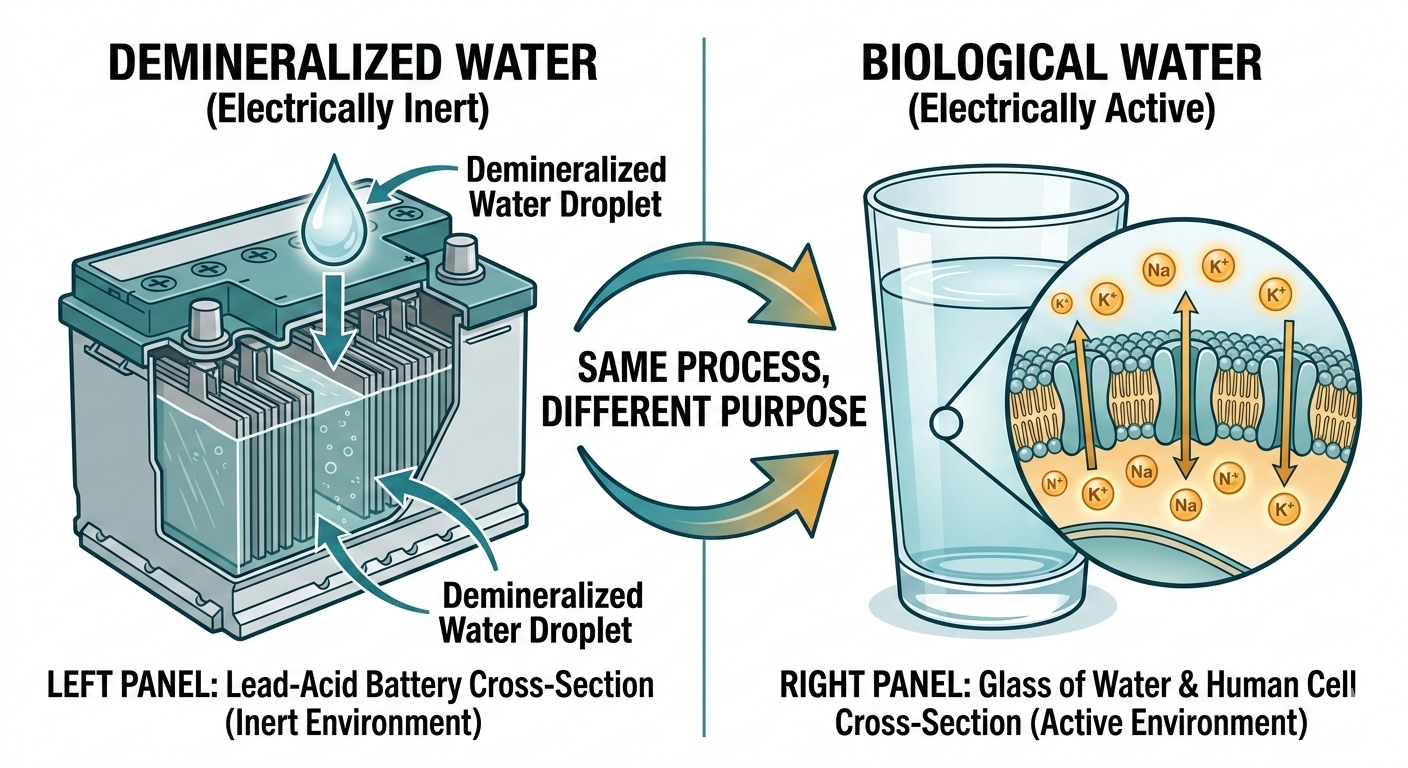
Walk into any auto parts store and pick up a bottle of demineralized water for battery top-ups. Turn it over. Read the label.
“Not suitable for drinking.”
No chemicals added. No toxins introduced. Just water with everything removed. And yet the label tells you clearly: do not drink this.
Now consider what your reverse osmosis system produces every single day. Water forced through a membrane so fine it removes everything, minerals, electrolytes, trace elements, until what remains is as close to pure H2O as you can get at home. When you measure the tds drinking water level coming out of your RO tap, it reads somewhere between 10 and 50 PPM. When you measure industrial battery water, it reads 0 to 5 PPM.
The gap is smaller than most people would be comfortable knowing.
Our research indicates this is not a coincidence. It is a clue the filtration industry never wanted you to follow.
Why Mechanics Use Demineralized Water in Batteries
To understand why this matters, you need to understand why demineralized water exists in the first place.
Inside a lead-acid battery, mineral deposits are the enemy. When tap water is used, the calcium and magnesium ions bond to the lead plates, forming a physical crust that blocks the electrical flow. The battery loses its ability to hold charge. It dies faster.
So engineers solved the problem by using demineralized water, stripped of every mineral, as a chemically inert space-filler. It keeps the acid levels topped up without interfering with the battery’s internal chemistry. It is designed to be passive. Electrically neutral. Biologically dead.
That is precisely what makes it useful in a machine and dangerous in a living body.
Your Body Is Not a Battery. It Is the Electricity Itself.
Here is where the analogy flips and becomes the most important thing you will read today.
A battery needs inert water because the battery generates its own charge through acid. The water is just a medium, a passive participant. Your body works on the opposite principle. Your cells do not contain acid that generates charge independently. Your cells require minerals dissolved in water to create the charge themselves.
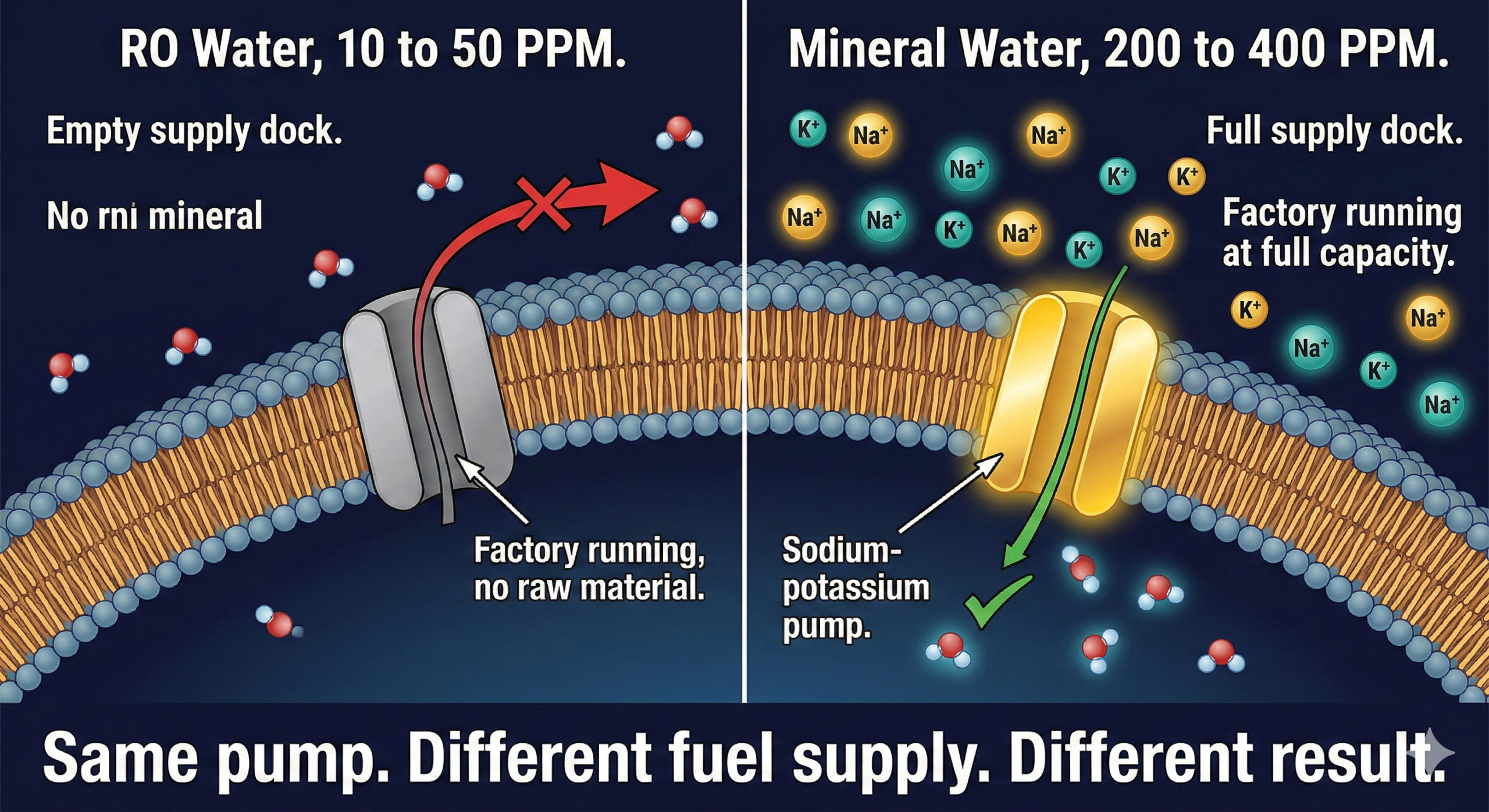
Inside every cell in your body sits a microscopic mechanism called the sodium-potassium pump. Think of it as the factory floor manager of your cell. Its job is to continuously push three sodium ions out of the cell and pull two potassium ions in, running this exchange thousands of times per second, every second of your life.
This constant movement of charged particles is what creates the electrical gradient that powers the cell. That gradient is also what pulls water molecules inside through separate water channels. No gradient, no water entry. No water entry, no cellular function (Advances in Physiology Education, 2015).
Here is the critical part. This pump runs on ionic minerals dissolved in the water surrounding your cells. At 200 to 400 PPM, natural spring water gives the pump a rich supply of raw material to work with. At 10 to 50 PPM, reverse osmosis water gives the factory an almost empty supply dock. The factory shows up for work. The delivery trucks never arrived.
A battery uses water as a bystander. Your body uses water as the wire. Strip the wire of its conducting material and the current stops flowing, regardless of how much water you drink.
The Number That Changes Everything
Here is the data point the filtration industry does not put on their marketing material.
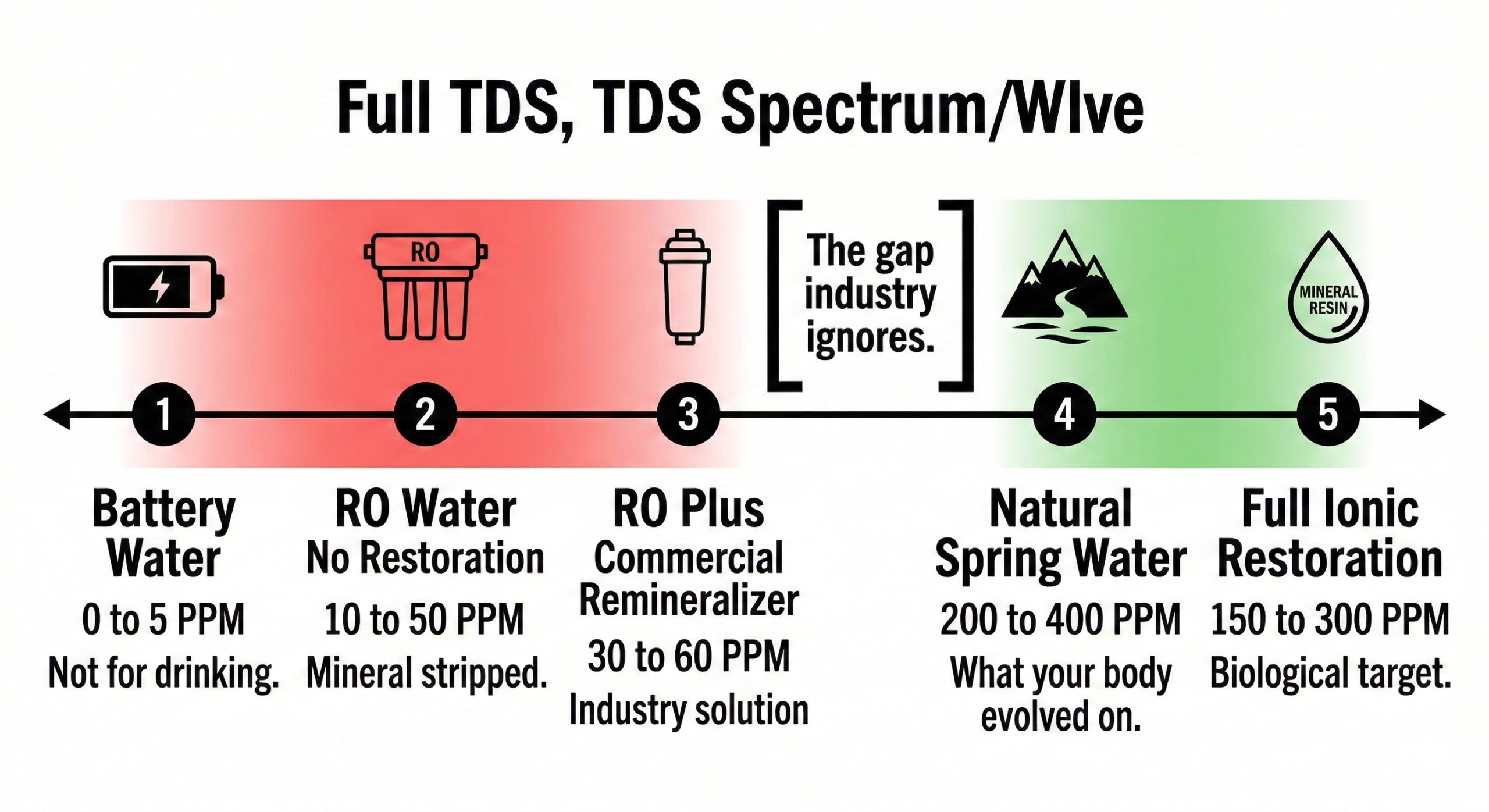
Total dissolved solids in drinking water, measured in Parts Per Million or PPM, is the most direct way to see how much biological material your water actually carries. When you line these numbers up side by side, the comparison becomes impossible to dismiss.
Water Type | TDS Range (PPM) | Biological Status |
Industrial demineralized battery water | 0 to 5 PPM | Labeled not for drinking |
Reverse osmosis water, no restoration | 10 to 50 PPM | Sold as healthy |
RO with commercial remineralization cartridge | 30 to 60 PPM | Marketed as complete solution |
Natural mineral spring water | 200 to 400 PPM | What your body evolved on |
Full ionic restoration, Penantia method | 150 to 300 PPM | Mimics natural spring water |
Read that again slowly.
The ro water tds value of a standard home system sits at 10 to 50 PPM. The ideal tds for drinking water, according to our interpretation of WHO guidelines and established physiology research, sits between 150 and 300 PPM. The commercial remineralization cartridge that most filtration companies sell as the solution moves you from 10 to 50 PPM up to just 30 to 60 PPM. That is not restoration. That is a gesture.
The water tds level your body evolved receiving from natural sources is 200 to 400 PPM. Your RO system delivers 10 to 50 PPM. The industry’s fix delivers 30 to 60 PPM. The gap between where most people are and where the biology says they should be is not a small adjustment. It is a category difference.
This is not an analogy anymore. This is a measurement.
Both processes, industrial demineralization and reverse osmosis, aim for the lowest possible TDS. Both strip out minerals alongside contaminants. Both produce water that is osmotically aggressive, meaning it actively seeks minerals from its surrounding environment to reach equilibrium.
According to the World Health Organization, consuming water with near-zero mineral content causes the body to increase the elimination of sodium, potassium, chloride, calcium, and magnesium through urine (Kozisek, 2005). The water enters your system hungry. It pulls electrolytes from your tissues to satisfy its osmotic imbalance, and then your kidneys flush the whole mixture out.
You are not hydrating. You are cycling minerals out of your body with every glass.
The Objection Worth Addressing
“But battery water has industrial chemicals in it. My RO water is clean. That makes them completely different.”
This is the most common pushback and it deserves a precise answer.
Standard demineralized battery water does not contain added chemicals. It is labeled undrinkable specifically because it is empty, not because it is toxic. The warning exists because engineers understood that a living system cannot function on water that has had its mineral intelligence removed.
Questions like “is ro water good for health” and “what are the reverse osmosis water side effects” generate hundreds of searches every month because people are beginning to sense that something is off. Our interpretation of the research is that the discomfort is real and the mechanism is measurable. Your RO water has removed genuine threats: fluoride, PFAS, heavy metals, chlorine. That is valuable and necessary. But clean and functional are two different standards.
A perfectly sterile surgical theatre with no instruments is clean. It cannot perform surgery. The label on the battery bottle is not warning you about what was added. It is warning you about what was taken away. Your RO system takes away the same things.
The Best TDS for Drinking Water: What the Biology Actually Says
The question most people never think to ask when they install a water filter is: what is the best tds for drinking water and does my system actually deliver it?
Our research indicates the answer has two parts. First, the recommended tds for drinking water should reflect the mineral richness of natural water sources that human biology evolved alongside, sitting between 150 and 300 PPM at minimum. Second, the minerals must be in an ionic state to be biologically useful: simply adding inorganic minerals to reach a TDS number is not sufficient if the body cannot absorb them.
The mineral water vs ro water debate misses this point entirely. Most people frame the question as purity versus contamination. The biological blueprint suggests the real question is conductivity versus inertness. Natural mineral water at 200 to 400 PPM carries the ionic charge the sodium-potassium pump requires. RO water at 10 to 50 PPM does not, and commercially remineralized RO water at 30 to 60 PPM barely moves the needle.
The Restoration Principle: From Battery Grade to Biological Grade
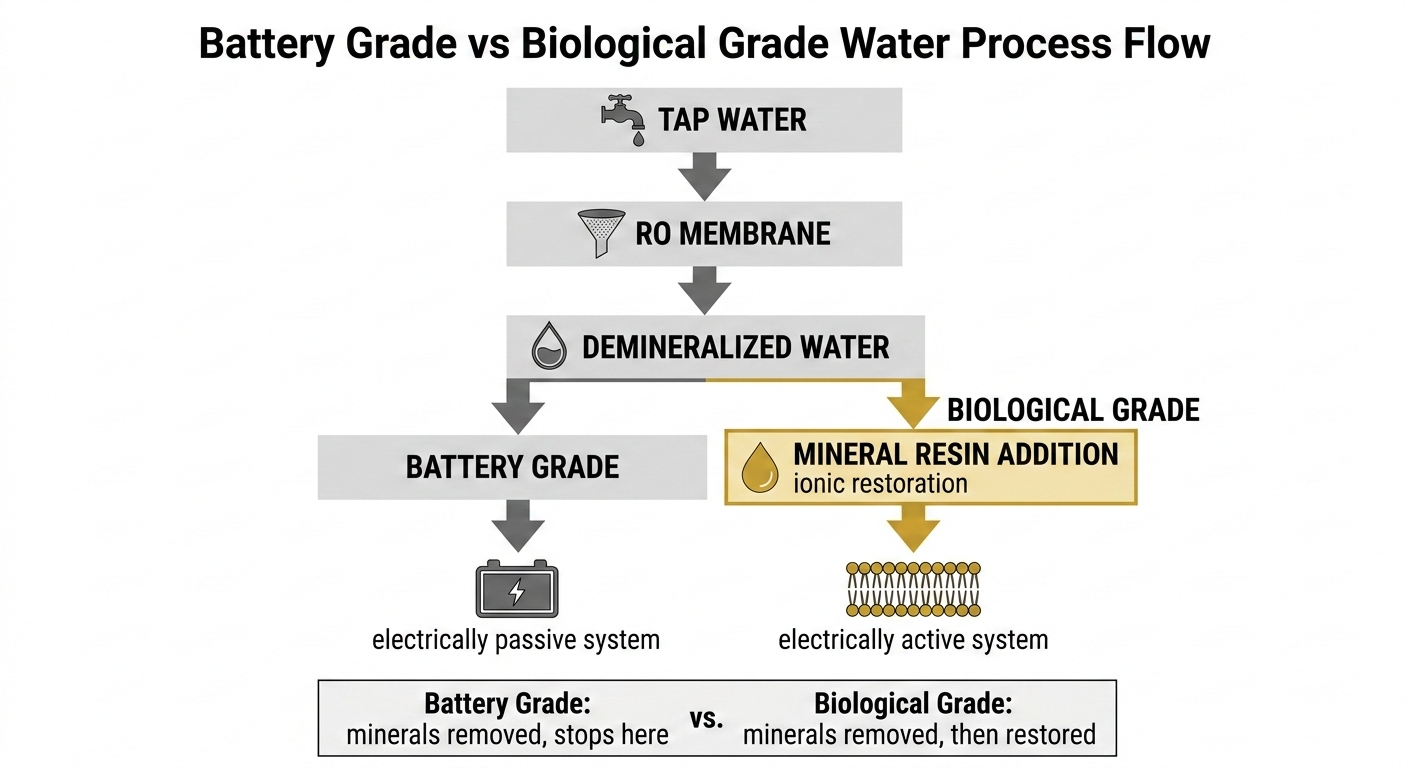
The mechanics who maintain industrial batteries understand something important. Demineralized water belongs in systems designed to be electrically passive. The moment you need electrical activity, you need a different kind of water entirely.
Your body needs electrical activity every second of every day.
The biological blueprint suggests that water becomes biologically functional when it carries a full-spectrum ionic mineral matrix, the kind found naturally in water that has traveled through mineral-rich geological formations over time. These minerals, when in their ionic state, provide the conducting medium the sodium-potassium pump requires to move water across cell membranes efficiently.
Our research indicates that the missing step in most home filtration setups is not better filtration. It is deliberate restoration. Using your reverse osmosis system to remove contaminants is the correct first step. Stopping there is where the system fails. Adding an organic mineral resin, rich in fulvic acid and a broad ionic mineral spectrum, completes the process and takes the water from battery-grade to biological-grade. The tds level for drinking water rises from 10 to 50 PPM to 150 to 300 PPM, and the minerals arrive in a form the cell actually recognizes.
The scrub removes the interference. The restoration provides the charge. Both steps are necessary. Neither one alone is sufficient.
What This Means for Your Daily Practice
If you are currently drinking reverse osmosis water without any form of mineral restoration, you are drinking the functional equivalent of what mechanics use to maintain machines designed to be electrically inert.
Your body is not inert. It is running a continuous electrical operation across trillions of cells simultaneously. The water you give it needs to match that demand. The next time you test your water with a TDS meter and see a reading between 10 and 50, you will know exactly what that number means and why it matters.
In our complete guide to cellular hydration, we detail the full hydration circuit and how each element, the mineral matrix, the organic carrier, and the electrical charge, works together to move water from your glass into your cells where it actually does its job.
The battery label was never just a warning for mechanics. It was a clue about what living systems actually need from water. You just had to know where to look.
Have you ever tested your water with a TDS meter? Tell us what number you got and what shifted for you after reading this.
Scientific References
- Kozisek, F. (2005). Health risks from drinking demineralized water. World Health Organization (WHO).
- Advances in Physiology Education (2015). The Sodium-Potassium Pump and Osmotic Pressure. American Physiological Society.
- National Research Council (1980). Drinking Water and Health: Volume 3. National Academies Press.
The information in this post reflects our interpretation of available scientific research and is intended for educational purposes only. It is not medical advice, diagnosis, or treatment. Always consult a qualified health provider regarding any medical condition.
This post does not exist to sell you anything. No recommended products, no affiliate links, no agenda beyond giving you access to research that deserves more attention than it gets. We are not asking you to believe us. We are asking you to think.
Scientific References
- Braak, H., et al. (2003). Staging of brain pathology related to sporadic Parkinson’s disease. Neurobiology of Aging.
- Borghammer, P., & Van Den Berge, N. (2021). The Brain-First vs. Body-First Hypothesis of Parkinson’s Disease. Frontiers in Neuroscience.
- Shannon, K. M., et al. (2012). Alpha-synuclein in colonic submucosa in early untreated Parkinson’s disease. Movement Disorders Journal.
The information in this post reflects our interpretation of available scientific research and is intended for educational purposes only. It is not medical advice, diagnosis, or treatment. Always consult a qualified health provider regarding any medical condition.
This post does not exist to sell you anything. No recommended products, no affiliate links, no agenda beyond giving you access to research that deserves more attention than it gets. We are not asking you to believe us. We are asking you to think.