
Sleep Deprivation Symptoms: What Poor Sleep Is Actually Doing to Your Body and What to Do About It
Home Sleep Deprivation Symptoms: What Poor Sleep Is Actually Doing to Your Body...
Read Article
Something has broken down. You are shaking, or crying without knowing exactly why, or you just cannot cope with things that were fine last week. The ordinary feels impossible right now.
That is not a permanent state. It is your nervous system telling you it has run out of capacity. Not weakness. Not falling apart. A system that has hit its limit.
Here is what to do. The explanation of why this happens is further down, for when you are ready for it.
BEFORE YOU READ FURTHER If you are experiencing thoughts of harming yourself or someone else, inability to sleep for multiple consecutive nights, severe panic cycles you cannot interrupt, complete functional incapacity where you cannot perform basic self-care, or if you feel you cannot keep yourself safe, please contact emergency services or go to your nearest emergency department now. This post is not the right resource for that situation. If your symptoms are severe and came on very suddenly, if you are experiencing psychosis, significant confusion, or inability to care for yourself, please see a GP or mental health clinician as the first step rather than a self-directed approach. If you are functional but at your absolute limit, exhausted, emotionally flooded, physically depleted, and recognising that you have reached a breaking point, this post is written for you |
Some of these, not necessarily all of them.
Emotional flooding: crying that comes without a specific trigger, or an inability to stop once it starts.
Physical shaking or trembling: particularly in the hands, or a physical sense of internal vibration.
Inability to cope with ordinary demands: tasks that were previously routine now feel overwhelming or impossible to start.
Withdrawal: a strong pull away from people, responsibilities, or any input that requires a response from you.
Physical symptoms: headaches, nausea, chest tightness, exhaustion that sleep does not resolve, or a feeling of physical heaviness.
Cognitive shutdown: difficulty concentrating, making decisions, or forming thoughts clearly.
A sense of unreality: feeling detached from yourself or your surroundings, or feeling like you are watching yourself from a distance.
If several of these are showing up together and have been getting worse, not better, over the last few days or weeks: you are in the right place. Keep reading.
Cancel what can be cancelled. Hand off what can be handed off. Tell whoever needs to know that you are not available right now.
Not forever. Just right now.
Your system cannot settle while it is still being asked to respond to things. Every new input is another demand on a system that has already run out of capacity. The first thing is to reduce the incoming load. Nothing else works as well until that happens.
This is not giving up. It is the first step of recovery.
Warm shower or bath. Lie down. If you can do both, do both.
Heat shifts your body out of the alert state. Lying down removes the physical readiness that standing or sitting upright maintains. Neither of these is complicated. Both of them work.
The breathing piece is the most important thing in this list. Breathe in for four counts. Breathe out for six to eight. Slower out than in. Do this for five minutes.
That longer exhale is not just relaxation advice. It directly signals the part of your nervous system that produces calm. You do not need to believe it will work. Just do it for five minutes before you do anything else that requires a decision.
Warm water with dissolved minerals while you do this. Research supports the role of magnesium and other minerals in stress regulation, and these are depleted under sustained stress. Replenishing them during the stabilisation phase supports the recovery environment.
Sustained stress burns through magnesium. Not slowly. Rapidly, with every activation. And magnesium is what your nervous system uses to calm itself down after being activated.
When it is depleted, the calming mechanism does not work properly. You can remove the demand, you can lie down, you can do the breathing, and the system still cannot fully settle because it is missing the raw material it needs to do that.
Magnesium is the most relevant mineral here. Research supports its role in GABA signalling and the stress response, and it is one of the minerals most commonly depleted under sustained stress. More bioavailable forms, whether ionic magnesium dissolved in warm water or magnesium glycinate capsules, are likely to be more useful than low-absorption forms like magnesium oxide. It will not resolve the acute state on its own. But supporting the mineral side of nervous system function during the stabilisation phase gives the other steps better conditions to work in.
Zinc and potassium are also part of the depletion pattern that accompanies sustained stress. Shilajit resin delivers a broad ionic mineral profile including these alongside magnesium, which addresses the multi-mineral gap that individual supplements typically do not.
WHAT TO DO ABOUT IT Stop what you can stop. Get warm. Lie down. Breathe out for longer than you breathe in, for five minutes. Sip warm water with ionic minerals. Do these four things in that order. Nothing on this list requires a decision, a plan, or anything to be organised. That is deliberate. Your system cannot do decisions right now. These work without needing it to. |
DOES THIS APPLY TO YOU? If you have removed demand, rested, and done the physical stabilisation steps and you are not feeling any shift within 24 to 48 hours, or if symptoms are worsening rather than stabilising, please see a GP. A nervous breakdown that does not begin to stabilise with rest and reduced demand warrants clinical assessment to rule out conditions that require clinical management including severe depression, anxiety disorder, or other conditions that can present similarly. |
That is what to do. If you want to understand why this happens, the next section explains the mechanism. If you just needed the steps, you have them.
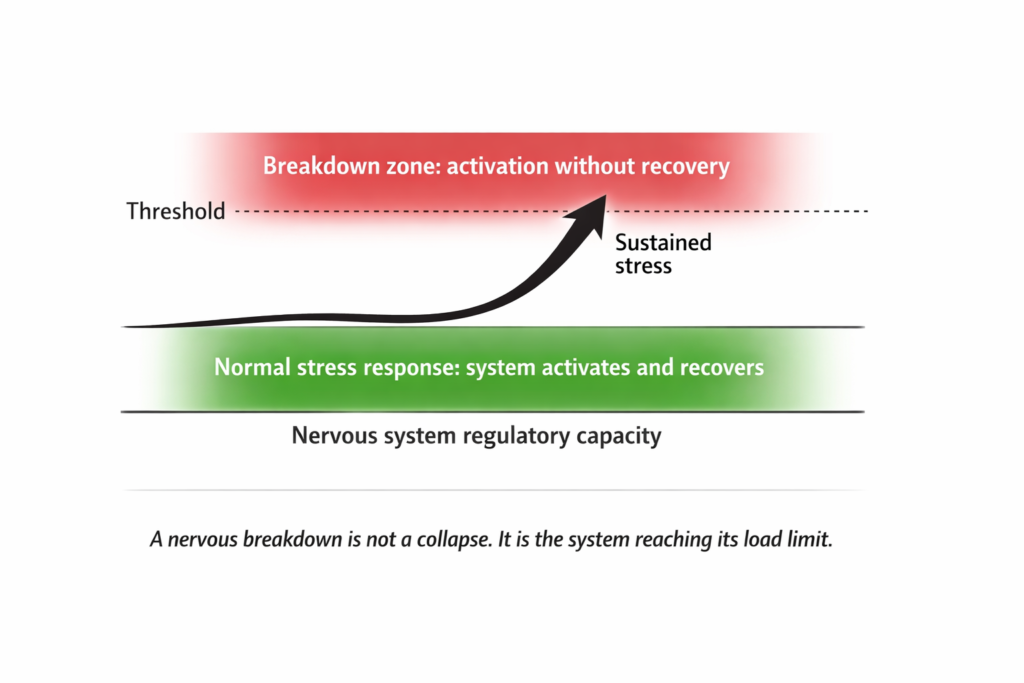
Your nervous system can handle a certain amount. Stress arrives, the system activates, the stressor passes, the system recovers. That is the design.
A nervous breakdown is what happens when that cycle has not been completing properly for long enough. The activation keeps happening. The recovery does not. At some point the system has used up everything it had.
The shaking, the crying, the inability to cope with ordinary things: those are not signs of permanent damage. They are the system communicating that it has nothing left. It is not broken. It is empty. The difference matters because empty fills back up.
DEFINITION VAGUS NERVE The primary nerve of the parasympathetic nervous system, running from the brainstem through the body. It governs the body’s capacity to shift from stress activation back toward calm. Extended exhale breathing, warmth, and horizontal rest all activate the vagus nerve and shift the autonomic balance toward parasympathetic dominance. This is why these simple physical interventions produce measurable nervous system stabilisation rather than being merely comfort measures. |
The full mechanism behind why sustained stress depletes the minerals the nervous system needs is covered in our post on burnout symptoms and why rest alone does not restore the system.
Recovery is not linear and it does not happen on a schedule. But there is a rough shape to it, and knowing that shape helps when it feels like nothing is changing.
Days one to three: The acute phase. Rest, warmth, breathing, minerals. No significant decisions. Your nervous system literally cannot assess things clearly right now. This is not the time to figure out what needs to change in your life. It is the time to stop.
Days four to ten: If demand has genuinely reduced, the system starts to stabilise. Sleep usually improves first. The shaking and nausea settle. The emotional flooding may still come but there are longer gaps between waves.
Weeks two to four: Thinking starts to clear. Motivation comes back in small amounts. This is when you can start to look at what actually needs to change, not urgently, but honestly. A good therapist or counsellor is worth considering here. Not to fix the breakdown but to help you understand what led to it.
Weeks four onwards: Capacity returns. People who come through this well often say something shifted for them about what they will and will not take on going forward. The breakdown drew a line. Recovery is learning to keep it there.
DOES THIS APPLY TO YOU? If you are in the first few days: the only job right now is stabilisation. Not understanding. Not planning. Not fixing anything. Just stopping. The question of why this happened and what needs to change is real and important and it belongs to weeks two and three, not to the next 72 hours. Trying to solve it now makes the acute phase longer. |
The most commonly reported symptoms are emotional flooding including crying without a specific trigger, physical shaking or internal trembling, inability to cope with ordinary demands that previously felt manageable, withdrawal from people and responsibilities, physical symptoms including headaches and nausea and chest tightness, cognitive difficulty including inability to concentrate or make decisions, and a sense of unreality or detachment. These symptoms typically appear together and intensify over days to weeks before the acute breaking point. They are the nervous system expressing that it has run out of regulatory capacity, not signs of permanent damage.
Recovery varies considerably between people and depends on the depth of depletion, the length of the preceding stress period, and how effectively demand can be reduced. Many people report the most intense acute symptoms easing within the first week with genuine rest and demand removal. Broader recovery, including return to normal cognitive function and emotional stability, often takes several weeks. People with a longer history of sustained overdemand before the breakdown frequently find recovery takes longer than they expect. The most important factor is not pushing back into high demand before the system has genuinely stabilised, as this extends the overall recovery period significantly.
A nervous breakdown occurs when the nervous system’s regulatory capacity has been exceeded by sustained stress over time. The biology involves multiple interacting systems: the HPA axis stress response, mineral depletion including magnesium which research associates with GABA function and anxiety regulation, sleep disruption compounding the physiological load, and the cumulative cost of sustained activation without adequate recovery. No single mechanism tells the full story. What is consistent is the pattern: sustained overdemand without sufficient recovery, reaching a point where the system can no longer regulate itself normally. It is not a collapse but a load limit being reached.
The terms are used interchangeably and describe the same experience. Neither is a clinical diagnosis. What both terms describe is a state in which the nervous system has been overwhelmed past its regulatory capacity and can no longer manage ordinary demands. The experience varies in presentation: some people describe emotional flooding as the dominant feature, others describe physical symptoms, others describe cognitive shutdown. All three are expressions of the same underlying physiological state.
The immediate priority is demand removal: cancel or hand off everything that can wait, leave environments that require a response, and tell the people who need to know that you are not available right now. Then: get warm, get horizontal, and do extended-exhale breathing for five minutes. Breathe in for four counts and out for six to eight. Extended exhale breathing is well-supported for shifting the autonomic state toward calm through vagal activation. Sip warm water with dissolved minerals. These steps address the nervous system from the outside in without requiring decisions or organisation. If symptoms are severe, include inability to sleep for multiple consecutive nights, severe panic cycles, thoughts of self-harm, or functional incapacity, see a GP or go to an emergency department without delay.
ONE MORE THING BEFORE YOU GO If what you have read here describes your situation but something does not quite fit, tell us in the comments below. Tell us the three symptoms that feel most persistent and whether they came on gradually or suddenly. We read every comment and respond directly. If you are currently in the thick of it and this post helped you name what is happening, that is useful to know too. You do not need a question to leave a comment. |
Legal Disclaimer
The information in this post is intended for educational purposes only and does not constitute medical advice, diagnosis, or treatment. If you are experiencing a mental health crisis, thoughts of self-harm, or symptoms that are not stabilising with rest, please seek immediate professional support.

Never Miss any Updates From Blog!Never Miss any Updates From Blog!Never Miss any Updates From Blog!Never Miss any Updates From Blog!
Never Miss any Updates From Blog!




No products in the cart.