
Symptoms of Low Potassium: Muscle Cramps, Weakness, and Fatigue Explained
Low Progesterone Symptoms: Why One Hormone Shortage Produces So Many Different Problems at...
Read Article
You already know you feel terrible when you do not sleep well. The question is why your body produces such a specific and consistent set of symptoms when sleep is poor, and what you can actually do about each one.
The answer is not that your body is tired in a general sense. Each symptom on the list below has a specific cellular explanation. And each explanation points directly at a specific fix. Understanding both changes how you approach recovery.
The cognitive slowdown after poor sleep is not simply fatigue. It is neurons firing at reduced voltage.
The sodium-potassium pump runs continuously throughout the night consuming magnesium to maintain the electrical charge across every cell membrane. After five to six hours without mineral replenishment, reserves reach their lowest point. In neurons this means the signals governing thought, recall, and processing speed are firing below their normal threshold. Thinking requires more effort, recall is slower, and holding multiple ideas simultaneously becomes noticeably harder.
The fix is not more coffee. Caffeine forces neuronal firing regardless of the voltage deficit, which accelerates further depletion. The fix is restoring the ionic mineral supply the pump needs. Magnesium glycinate or ionic magnesium, taken consistently using the morning sipping protocol rather than a single dose, raises the baseline from which the overnight depletion begins. As cellular magnesium levels stabilise over one to two weeks, the brain fog pattern typically resolves.
The complete mineral restoration protocol is covered in our post on magnesium glycinate for sleep.
The vascular system runs on the same electrochemical infrastructure. Which is why the next symptom follows the same pattern.
Magnesium is a direct regulator of blood vessel tone. When levels drop after poor sleep, blood vessels lose regulatory precision and become more prone to the constriction and dilation patterns that produce pain signals. This is the same mechanism behind magnesium deficiency headaches and a significant proportion of tension headaches generally. The headache is not caused by stress in a vague sense. It is caused by a specific mineral deficit in a specific regulatory system.
.
DEFINITION : SODIUM-POTASSIUM PUMP
A protein engine in every cell membrane that maintains the electrical charge governing nerve signalling, muscle function, and cognitive processing. It runs continuously including during sleep, consuming magnesium in the process. When overnight reserves are depleted, neuronal firing slows and weakens. This is the cellular mechanism behind the brain fog that follows poor sleep.
The immediate response with the strongest evidence is magnesium intake alongside adequate hydration. The form matters: magnesium oxide at 4 percent absorption will not move the needle quickly enough. Magnesium glycinate at 50 to 80 percent absorption reaches the vascular system meaningfully. Consistent use over days rather than a single dose is what produces lasting relief rather than temporary improvement.
The heart muscle depends on the same electrical regulation. When the pump runs low, the effects extend beyond blood vessels.
Heart palpitations from poor sleep concern people more than almost any other symptom because they feel serious. The mechanism is specific and worth understanding clearly.
The heart muscle depends on precise sodium-potassium ratios across the cell membrane to contract and release in a coordinated rhythm. When the pump runs below capacity from mineral depletion, those ratios shift slightly. The electrical signals governing the heartbeat become less regular. The result is felt as a flutter, a missed beat, or a racing sensation. This is the same electrical dysregulation that produces muscle twitching and restless legs at night, applied to cardiac muscle.
If heart palpitations are frequent, severe, or accompanied by chest pain or breathlessness, consult a healthcare provider regardless of sleep status. The mechanism described here applies to sleep-related palpitations in otherwise healthy individuals.
Restoring sodium-potassium pump function through ionic mineral supplementation is the relevant fix. Magnesium and potassium are the two minerals most directly involved in cardiac electrical regulation. A full spectrum ionic mineral source that includes both, alongside the natural electrolyte balance found in Shilajit, addresses the cardiac electrical environment more completely than magnesium alone.
The nervous system that governs balance and gut function is equally dependent on the same mineral supply. Which explains the symptoms most people do not expect.
Nausea from lack of sleep and dizziness from sleep deprivation are less discussed but appear consistently because people experience them and cannot find a clear explanation.
The vestibular system governing balance and spatial orientation is highly sensitive to neuronal firing patterns. When those patterns are disrupted by mineral depletion, the brain’s ability to integrate spatial signals becomes less precise. This produces dizziness, particularly when moving quickly or changing positions.
The gut is affected through a separate but related pathway. The enteric nervous system runs on the same electrochemical signalling principles as the central nervous system. Disrupted neuronal function from mineral depletion affects gut motility and sensitivity, producing nausea independently of any digestive issue.
Both symptoms resolve as mineral reserves are restored and pump function improves. Hydration with ionic minerals rather than plain water is more effective here because plain water without minerals can temporarily worsen the osmotic imbalance that contributes to these symptoms. Sipping a one-litre bottle of water with ionic magnesium dissolved throughout the morning addresses both the hydration and the mineral deficit simultaneously.
We cover why plain water alone can worsen mineral depletion in our post on why drinking water may not be hydrating your cells.
symptom in this cluster is the one that most directly affects relationships and daily life, and it has the same root cause.
GABA, the nervous system’s primary calming neurotransmitter, depends on adequate magnesium at the receptor level to function properly. When magnesium is depleted overnight, GABA receptor sensitivity decreases. The nervous system’s ability to modulate its own reactivity drops. The threshold at which stimuli produce an emotional response lowers.
This is not a character flaw or a lack of emotional regulation. It is a predictable biological outcome of running the nervous system on depleted mineral reserves.
DEFINITION : GABA
Gamma-aminobutyric acid is the nervous system’s primary inhibitory neurotransmitter. It reduces neuronal excitability and produces calming effects throughout the brain and body. GABA requires adequate magnesium at the receptor level to function properly. When magnesium is depleted, GABA activity weakens and the nervous system becomes more reactive and harder to regulate.
Magnesium glycinate is the most relevant form here because the glycine component has independent calming effects on the nervous system alongside the magnesium. The combination addresses GABA function from two directions simultaneously. People who switch from magnesium oxide to glycinate typically notice the mood and irritability difference within one to two weeks, which is the timeframe for cellular magnesium levels to meaningfully stabilise.
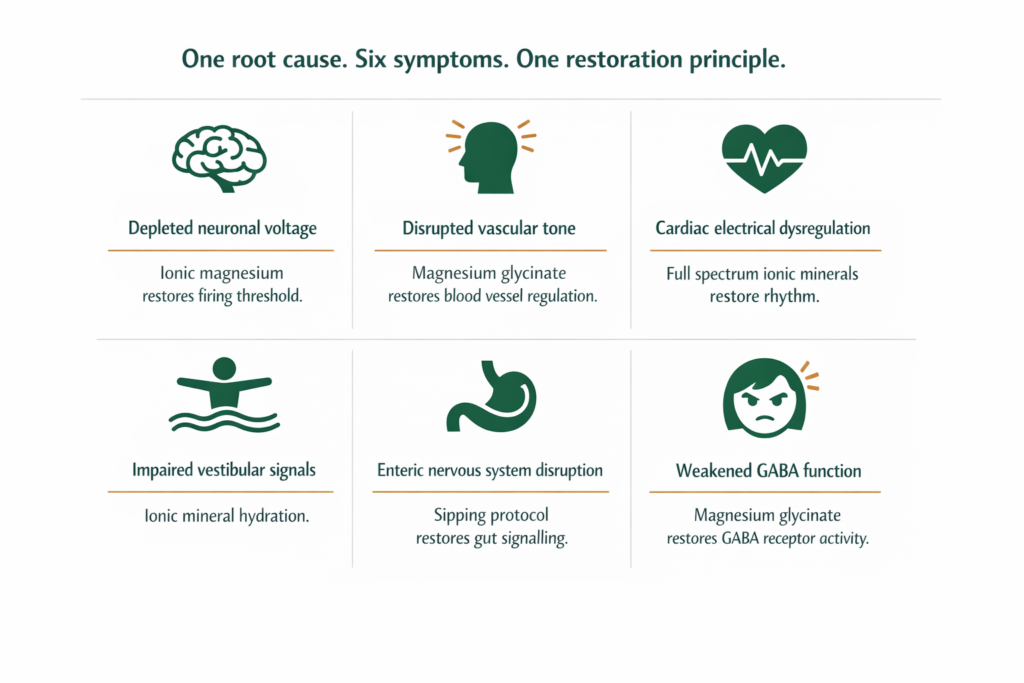
Brain fog, headaches, heart palpitations, dizziness, nausea, irritability. These look like an unrelated list. They are not. They are all downstream effects of the same upstream problem: the sodium-potassium pump running below capacity on depleted mineral reserves, producing electrical dysregulation across every system that depends on it.
This is why sleeping more without addressing the mineral deficit often fails to resolve the symptoms fully. Another night of sleep runs the depletion cycle again from the same depleted baseline. The symptoms persist because the mechanism driving them is not being addressed.
The restoration principle is consistent across all of them: restore the ionic mineral supply, restore pump function, restore the electrochemical infrastructure the dependent systems need to operate normally. The form of magnesium matters. The timing of delivery matters. Consistency over weeks rather than days is what produces lasting change.
Standard Thinking | The Biological Reality |
|---|---|
Sleep deprivation symptoms are caused by being tired | Each symptom is a specific downstream effect of mineral-depleted electrochemical infrastructure running below capacity |
Brain fog from poor sleep is psychological | Brain fog from poor sleep is a voltage problem at the neuronal level driven by overnight magnesium depletion |
Heart palpitations from poor sleep are stress-related | Heart palpitations reflect electrical dysregulation in cardiac muscle from depleted sodium-potassium pump activity |
Sleeping more will resolve the symptoms | Sleeping more without restoring mineral reserves repeats the depletion cycle from the same depleted baseline |
Irritability after poor sleep is emotional | Irritability after poor sleep is a direct consequence of weakened GABA receptor function from magnesium depletion |
The most consistently reported symptoms are brain fog and reduced cognitive speed, headaches from disrupted vascular tone, irritability from weakened GABA function, physical fatigue from impaired cellular energy production, and in some cases heart palpitations and dizziness from electrical dysregulation. These symptoms appear together because they share a common root cause: overnight mineral depletion reducing the electrochemical function that every dependent system relies on.
Yes, and the mechanism is specific. The vestibular system governing balance and the enteric nervous system governing gut function both depend on the same neuronal signalling infrastructure as the brain. When overnight mineral depletion reduces sodium-potassium pump activity and weakens neuronal firing, both systems are affected. The dizziness reflects impaired vestibular signal integration. The nausea reflects disrupted enteric nervous system function. Both resolve as ionic mineral levels are restored.
Heart palpitations from poor sleep reflect electrical dysregulation in the cardiac muscle from depleted sodium-potassium pump activity. The pump governs the precise sodium-potassium ratios that keep the heartbeat coordinated. When those ratios shift from mineral depletion, the electrical patterning of the heartbeat becomes less regular. The result is felt as a flutter, skipped beat, or racing sensation. This is not a cardiac event but warrants medical attention if frequent, severe, or accompanied by other cardiac symptoms.
The irritability is driven by weakened GABA receptor function. Magnesium depletion overnight reduces the effectiveness of GABA at the receptor level. The nervous system loses some of its ability to modulate its own reactivity. The threshold at which stimuli produce an emotional response drops. What would be a minor irritation on a well-rested day becomes a significant one on a depleted day because the biological buffer that normally absorbs it is not functioning at full capacity.
ONE MORE THING BEFORE YOU GO If something in this post resonated but also left a question unanswered, leave it in the comments below. We read every comment and respond with what the research says. We are not asking you to engage for the sake of it. We are offering to continue the conversation if something here pointed toward a question this post did not fully close. If a specific symptom, a specific experience, or a specific part of the mechanism did not land clearly, tell us. That is useful for us to know and we will answer with the same standard of evidence this post was written to. |
1. Abbasi, B., Kimiagar, M., Sadeghniiat, K., Shirazi, M.M., Hedayati, M. and Rashidkhani, B. (2012). The effect of magnesium supplementation on primary insomnia in elderly. Journal of Research in Medical Sciences, 17(12), 1161-1169.
2. Bhattacharyya, S., Pal, D., Gupta, A.K., Ganguly, P., Majumder, U. and Bhattacharya, S.K. (2009). Beneficial effect of processed Shilajit on swimming exercise induced impaired energy status of mice. Pharmacologyonline, 1, 817-825.
3. Boyle, N.B., Lawton, C. and Dye, L. (2017). The effects of magnesium supplementation on subjective anxiety and stress: a systematic review. Nutrients, 9(5), 429.
4. Firoz, M. and Graber, M. (2001). Bioavailability of US commercial magnesium preparations. Magnesium Research, 14(4), 257-262.
5. Held, K., Antonijevic, I.A., Kunzel, H., Uhr, M., Wetter, T.C., Golly, I.C., Steiger, A. and Murck, H. (2002). Oral Mg supplementation reverses age-related neuroendocrine and sleep EEG changes in humans. Pharmacopsychiatry, 35(4), 135-143.
6. Skou, J.C. (1997). The identification of the sodium-potassium pump. Nobel Lecture. Nobel Prize in Chemistry 1997. Nobel Foundation.
Legal Disclaimer
The information in this post reflects Penantia’s interpretation of available scientific research and is intended for educational purposes only. It does not constitute medical advice, diagnosis, or treatment. If you are experiencing persistent symptoms including heart palpitations, dizziness, or severe fatigue, consult a qualified healthcare provider.

Never Miss any Updates From Blog!Never Miss any Updates From Blog!Never Miss any Updates From Blog!Never Miss any Updates From Blog!
Never Miss any Updates From Blog!



No products in the cart.