
Sleep Deprivation Symptoms: What Poor Sleep Is Actually Doing to Your Body and What to Do About It
The answer is not that your body is tired in a general sense. Each symptom on the list below has...
Read Article
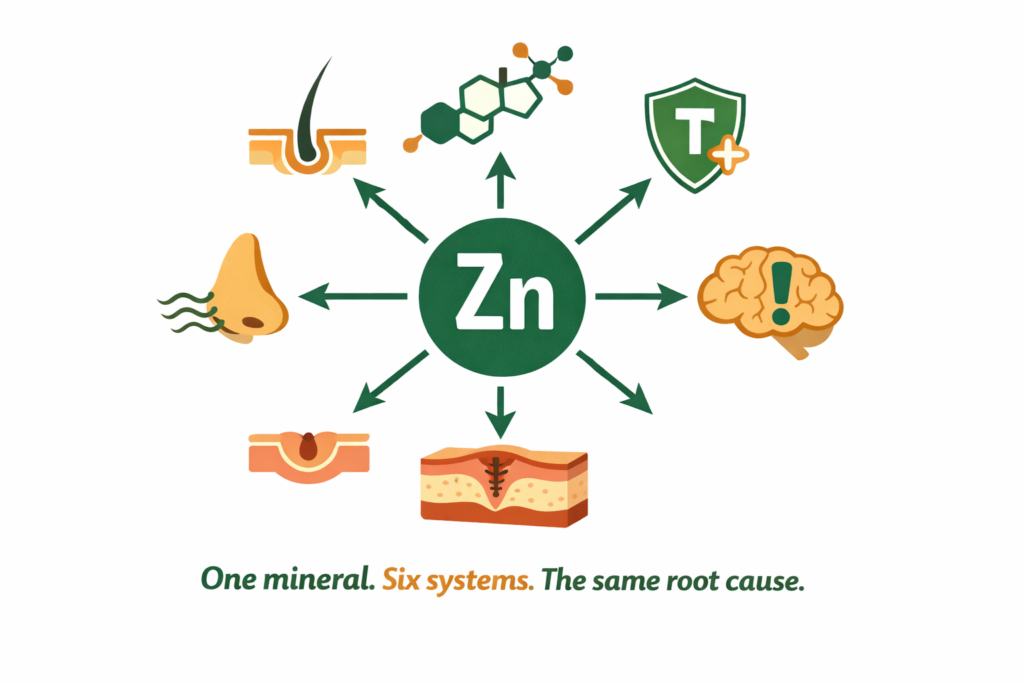
You are losing more hair than you used to. Your wounds are healing slowly. Your sense of taste feels duller. You have been more anxious lately without a clear reason. And if you are a man, your energy and drive have been lower than they should be.
You have probably searched these symptoms separately. Found separate explanations for each one. Maybe tried separate solutions. Nothing fully resolved.
Our research indicates this is almost always a single mineral shortage expressing itself across every system that depends on it simultaneously. Zinc is required for over 300 enzymatic processes in the human body. When it drops below functional levels, the systems it powers show symptoms at the same time. Not as connected problems. As what appear to be completely unrelated ones.
Before the mechanism, a brief check. Mark how many of these apply to you consistently, not occasionally.
You are losing more hair than is normal for you, particularly diffusely across the scalp. Your hair feels thinner or more brittle than it used to.
Cuts and minor wounds take noticeably longer to heal than you would expect. Skin issues like acne, dermatitis, or rough patches persist despite dietary changes.
Your sense of taste or smell has become duller. Food tastes less vivid. You notice smells less readily than you used to.
You are getting sick more frequently than those around you in similar environments, or recovering more slowly when you do get sick.
Your anxiety has increased without a clear situational explanation. It feels biochemical rather than triggered by specific circumstances.
You feel fatigued in a way that does not resolve with adequate sleep. A flat low energy rather than sleepiness.
If you are a man: your drive, motivation, and physical energy are lower than they were one to two years ago. Recovery from exercise is slower. Libido has decreased.
If you recognise four or more of these consistently, zinc deficiency is a strong candidate for the common thread. The mechanism below explains why.
BEFORE YOU READ FURTHER This post describes one specific mechanism that produces the symptoms above: intracellular zinc depletion affecting the enzymatic processes that depend on it. This is a real and common mechanism. It is not the only mechanism. See a healthcare provider before treating this as a zinc deficiency if: your symptoms appeared suddenly rather than gradually over months, your hair loss is severe or rapid, you have a diagnosed thyroid condition, autoimmune disease, or take medications affecting hormones or immunity, or if any symptoms are severe rather than the chronic low-grade pattern described here. The mineral mechanism described in this post is most relevant for people experiencing a gradual, multi-system, chronic pattern without a diagnosed underlying condition. If that is your situation, read on. |
This is the question most people have. Zinc is in red meat, shellfish, seeds, legumes. You eat these foods. Why would you be low?
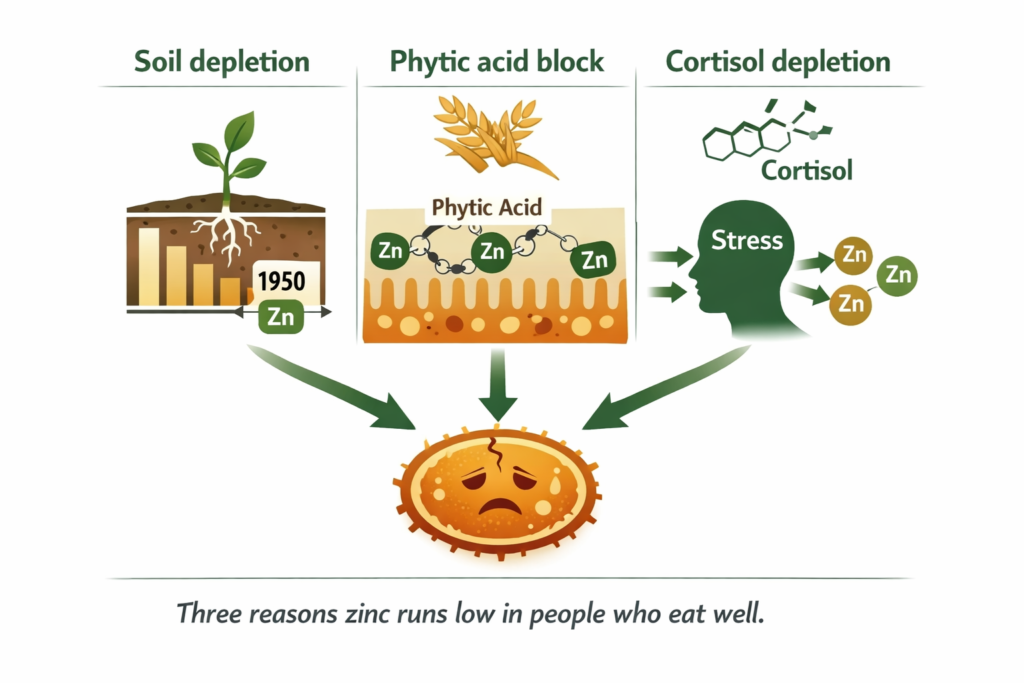
Three reasons. None of them are about your food choices.
The food has changed. The same soil depletion that has reduced magnesium content in food by 40 to 80 percent since 1950 has done the same to zinc. Plants grown in mineral-depleted soil have lower zinc content than the same plants grown a generation ago. The food looks identical. The mineral content is not.
Phytic acid blocks absorption. Wholegrains and legumes contain phytic acid, which binds to zinc in the gut and prevents absorption. Someone eating a wholefood diet rich in legumes and wholegrains may be consuming adequate zinc on paper while absorbing far less than the stated amount. Animal sources have better zinc bioavailability precisely because they do not contain phytic acid.
Cortisol depletes zinc directly. Every cortisol activation consumes zinc alongside magnesium. Chronic stress means chronic zinc depletion regardless of dietary intake. This is the pathway most people have not accounted for. They eat well, they exercise, but they have been under sustained stress for months. The zinc is going out faster than it is coming in.
DEFINITION PHYTIC ACID A compound found naturally in wholegrains, legumes, and seeds that binds to zinc, iron, and magnesium in the digestive tract and prevents their absorption. Also called phytate. Foods high in phytic acid can significantly reduce the zinc available from a meal even when zinc content appears adequate on the nutrition label. This is why populations eating primarily plant-based diets have higher rates of zinc deficiency despite eating zinc-containing foods. |
WHAT TO DO ABOUT IT Understanding the cause changes the strategy. If stress is the primary driver, zinc restoration alone is insufficient without also addressing the cortisol pathway that is continuously depleting it. If phytic acid is the issue, the form of zinc supplementation and the timing relative to meals becomes the critical variable. The morning sipping protocol delivers ionic zinc through the day in dissolved form that does not compete with phytic acid binding in the gut. |
DOES THIS APPLY TO YOU? If you eat a diet rich in legumes, wholegrains, or fortified plant-based foods, and if you have been under sustained stress for more than four to six weeks, both the phytic acid absorption block and the cortisol depletion pathway are almost certainly active simultaneously. If your diet is primarily animal-source foods and stress is low, the soil depletion explanation is more likely the dominant factor. |
Hair loss from zinc deficiency is consistently the most distressing symptom presentation and one of the most misattributed. People experiencing it are told it is stress, hormonal, genetic, or seasonal. The mineral connection is rarely investigated.
The mechanism is specific. Zinc is required for the production of keratinocytes, the cells that form the hair shaft, and for the function of follicle stem cells that initiate new hair growth cycles. When zinc is depleted, two things happen simultaneously. Existing hair becomes brittle and breaks more easily. New hair growth slows because the follicle stem cells cannot initiate growth cycles without adequate zinc. The result is diffuse thinning across the scalp rather than patterned recession, which is why it is often mistaken for stress-related shedding.
The copper connection matters here specifically. Zinc and copper share the same absorption pathway in the gut. High-dose isolated zinc supplementation can deplete copper over time, and copper deficiency independently causes hair loss and changes in hair texture and colour. This is why taking high-dose zinc oxide or zinc picolinate as a standalone supplement can sometimes fail to improve or even worsen a hair situation. The mineral balance matters as much as the zinc level.
WHAT TO DO ABOUT IT Ionic zinc delivered alongside the full mineral spectrum, including copper in balanced proportions, addresses the deficiency without creating the zinc-copper imbalance that isolated high-dose supplementation can produce. This is the specific argument for a full-spectrum ionic mineral source over isolated zinc supplementation for hair-related zinc deficiency. The follicle stem cells require both zinc and copper to function correctly. Restoring one while depleting the other does not restore hair growth. |
DOES THIS APPLY TO YOU? If your hair loss is diffuse rather than patterned, meaning thinning across the whole scalp rather than receding at the hairline or temples in a defined pattern, zinc deficiency fits the mechanism. If you have been taking isolated high-dose zinc and the situation has not improved, copper depletion from the supplementation itself may be a factor. If any of the following apply, a GP assessment is the right first step before supplementation: hair loss appeared suddenly within weeks, you are a woman over 40 with other hormonal symptoms, you have a known thyroid condition, you recently changed medications, or loss is severe rather than gradual. Zinc may still be a contributing factor in those cases but it is not the starting point. |
Several other symptoms appear in the zinc deficiency data at lower volume but are clinically significant enough to address. They share the same root cause and often appear together with hair loss in people with established zinc depletion.
Taste and smell: Zinc is required for the production of gustin, a protein essential for taste perception, and for the function of olfactory receptors governing smell. The resulting dulling of both senses is one of the most zinc-specific symptoms on the checklist. Almost nothing else produces this symptom pattern outside of acute illness. If taste and smell dulling is present alongside other symptoms, the zinc connection is very strong.
Wound healing: Zinc is required at every stage of wound healing including inflammation, tissue formation, and remodelling. Slow healing of minor cuts over two to three weeks rather than five to seven days is a reliable sign that zinc is insufficient for the repair processes the body needs to run continuously.
Anxiety: Zinc modulates NMDA receptor function, a glutamate receptor involved in neurological excitability. When zinc is insufficient, NMDA receptor signalling becomes dysregulated, producing neurological hyperexcitability experienced as anxiety without a clear situational trigger. This is a different receptor pathway from the magnesium-GABA mechanism but produces a similar biochemical anxiety pattern.
Fatigue: The sodium-potassium pump that powers cellular energy requires zinc alongside magnesium for full enzymatic function. Zinc depletion compounds magnesium depletion in its effect on cellular energy production, producing a flat low energy rather than the sleepy tiredness of sleep deprivation.
We cover the zinc-immune connection in full in our post on weak immune system symptoms and what your body is actually missing.
WHAT TO DO ABOUT IT The solution for all of these symptoms is restoring intracellular zinc through an ionic delivery form that reaches the cells where these processes occur. The same morning sipping protocol that delivers ionic magnesium delivers ionic zinc simultaneously from the same source. The minerals work together rather than competing, which is the practical advantage of a full-spectrum ionic source over taking separate isolated supplements for each deficiency. |
DOES THIS APPLY TO YOU? If taste and smell dulling is present alongside other symptoms from the checklist, the zinc connection is highly specific. If immunity and wound healing are your primary concerns and coincide with sustained stress, address the cortisol pathway alongside zinc restoration. If anxiety is your dominant symptom, read both this post and the magnesium deficiency post as both minerals are relevant. However, if anxiety is severe, persistent, and significantly affecting your daily function, that warrants assessment by a mental health professional regardless of mineral status. Minerals may be a contributing factor. They are not a substitute for clinical support when anxiety is at a clinical level. Similarly, if frequent illness is severe or you have a diagnosed immune condition, mineral restoration supports but does not replace specialist medical management. |
If you searched something like ‘does zinc increase testosterone’ and arrived at this post, the answer is yes. But the mechanism is more specific than most sources explain, and the form determines whether your answer in practice matches the answer in theory.
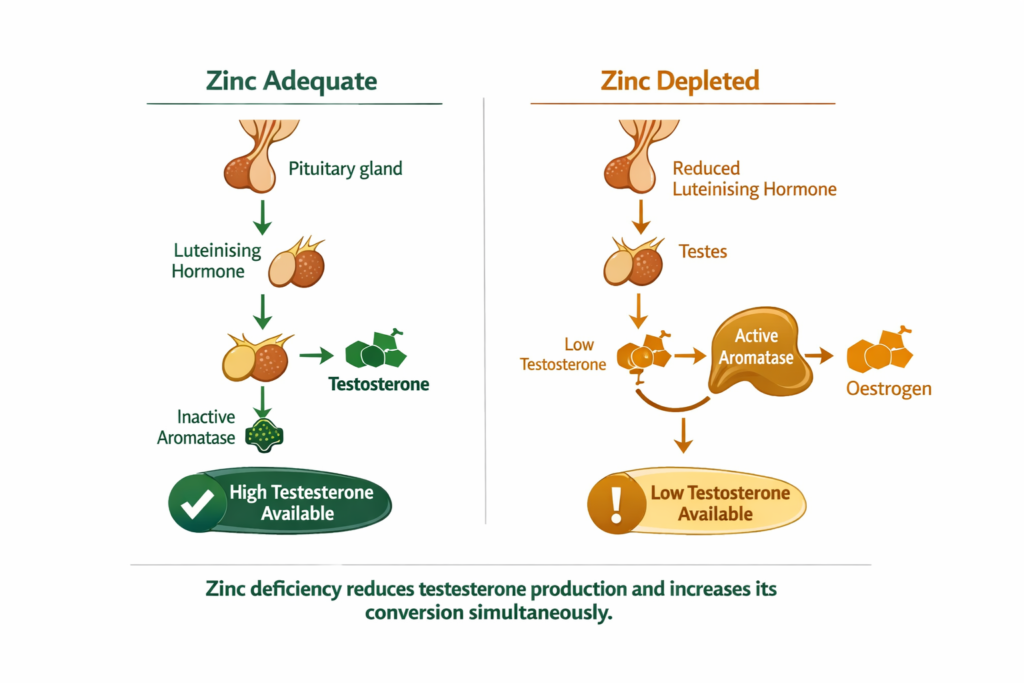
Zinc is required for the production of luteinising hormone in the pituitary gland. Luteinising hormone is the signal that tells the testes to produce testosterone. Without adequate zinc, the pituitary cannot produce sufficient luteinising hormone, and without sufficient luteinising hormone, testosterone production drops regardless of other factors. This is not a correlation. It is a direct enzymatic dependency.
Zinc also acts as a natural aromatase inhibitor. Aromatase is the enzyme that converts testosterone to oestrogen. When zinc is depleted, aromatase activity increases, meaning more testosterone is converted before it can be used. The combined effect of reduced production and increased conversion produces a testosterone environment significantly below what the body would maintain with adequate zinc.
DEFINITION AROMATASE An enzyme responsible for converting androgens including testosterone into oestrogens. Zinc acts as a natural aromatase inhibitor, meaning adequate zinc reduces the rate of testosterone conversion. When zinc is depleted, aromatase activity increases and more testosterone is converted to oestrogen before it can be used. This is one reason zinc deficiency produces symptoms overlapping with low testosterone even before blood testosterone levels drop to a clinically flagged level. |
The magnesium and zinc combination also matters for testosterone. Magnesium is required for the enzymatic step that produces free testosterone from total testosterone. Taking both together through a full-spectrum ionic source addresses the complete testosterone production pathway rather than one step of it.
WHAT TO DO ABOUT IT Zinc does increase testosterone. Consistently and through a specific mechanism. But the form determines whether the zinc you take reaches the pituitary and the testes at the concentration required to make that difference. Zinc oxide at 20 percent absorption delivers approximately 10mg from a 50mg tablet. The pituitary requires consistent zinc availability to produce adequate luteinising hormone. 10mg is not that. Ionic zinc at 80 to 90 percent absorption delivers 40 to 45mg from the same stated dose. That is the threshold at which the mechanism becomes clinically meaningful. |
DOES THIS APPLY TO YOU? If you have tried zinc supplements for testosterone and noticed limited effect, the form is almost certainly the explanation if you took oxide or gluconate forms. If your testosterone symptoms coincide with sustained stress, the cortisol depletion pathway is compounding the deficiency. However, if any of the following apply, a GP assessment and hormone panel are the appropriate first step rather than supplementation: symptoms appeared rapidly rather than gradually over a year or more, you have other symptoms such as significant testicular pain or swelling, you are under 30 with severe symptoms, or you have a known pituitary or endocrine condition. Zinc depletion is a common and addressable contributor to sub-optimal testosterone in otherwise healthy men. It is not a substitute for clinical investigation when more serious underlying causes are possible. |
The form section matters for zinc more than for almost any other mineral because the gap between the worst and best absorbed forms is larger than most people realise, and because it directly explains why previous supplementation attempts produced limited results.
Form | Absorption | From 50mg, cells receive | Commonly Found In |
|---|---|---|---|
Zinc Oxide | 20% | ~10mg | Most multivitamins, budget supplements |
Zinc Gluconate | 30-40% | ~15-20mg | Lozenges, mid-range supplements |
Zinc Picolinate | 40-60% | ~20-30mg | Quality standalone supplements |
Zinc Glycinate | 50-65% | ~25-32mg | Quality mineral supplements |
Ionic Zinc via Fulvic Acid | 80-90% | ~40-45mg | Shilajit resin, fulvic mineral sources |
The difference between zinc oxide and ionic zinc is not a marginal improvement. It is the difference between 10mg reaching your cells and 40mg reaching your cells from the same stated dose. T-cell production, testosterone synthesis, keratinocyte production for hair, and aromatase inhibition all require zinc at the intracellular level. Only ionic delivery via fulvic acid reliably crosses both the gut wall and the cell membrane to reach that environment.
The copper point bears repeating here. Isolated high-dose zinc supplementation over time can deplete copper. Copper deficiency produces its own symptom set including fatigue, hair changes, and neurological symptoms that can overlap with zinc deficiency symptoms in a confusing way. A full-spectrum ionic mineral source delivers zinc and copper in proportions that reflect the mineral balance the body requires, rather than flooding one mineral at the expense of another.
WHAT TO DO ABOUT IT Before increasing your zinc dose, check the form. Before concluding zinc deficiency is not your issue, check whether the form you took could plausibly have delivered a meaningful intracellular dose. If you have been taking zinc oxide at 50mg per day, your cells have been receiving approximately 10mg. That is the variable most people have not accounted for, and it is the one that explains why the standard supplement approach produced limited results. |
DOES THIS APPLY TO YOU? Check the label of any zinc supplement you have tried. Zinc oxide or zinc found inside a multivitamin means 20 percent absorption. Zinc gluconate in a lozenge means 30 to 40 percent. If you tried either of these and concluded zinc does not help your symptoms, you were working with a fraction of the stated dose. Try ionic zinc before concluding zinc deficiency is not your issue. If you tried zinc picolinate consistently for four or more weeks at a meaningful dose and noticed nothing, the cortisol depletion rate and the intracellular delivery step are the next variables to examine. |
If you have had a blood test that showed normal zinc levels and concluded zinc deficiency is not your issue, the logic is understandable but the conclusion may not follow from the evidence. Here is why.
The serum zinc test measures zinc dissolved in blood plasma. Plasma zinc represents approximately 0.1 percent of the body’s total zinc. The remaining 99.9 percent sits inside cells and in bone, where it actually performs the functions we have been describing throughout this post.
The body defends plasma zinc aggressively, the same way it defends blood glucose and blood pH, because zinc in the bloodstream is required for immediate enzymatic function. When intracellular zinc drops, the body draws from cellular stores to maintain the plasma level. This is the compensatory mechanism. The blood test looks normal because the compensation is working. But the compensation working means intracellular stores are being drawn down to make it work.
A normal serum zinc test does not mean your zinc is fine. It means your body is still successfully compensating. The symptoms appear during the compensatory phase, before the blood test would ever flag anything. The test only fails when compensation fails completely, which is the frank clinical deficiency the test was designed to catch. Everything before that point is invisible to it by design.
SERUM ZINC TEST: WEAK CLUE FOR THIS QUESTION Measures plasma zinc: 0.1 percent of total body zinc. The body maintains this reading by drawing from intracellular stores when cellular zinc drops. A normal result means the compensatory mechanism is working. It tells you nothing about whether intracellular zinc, which is where hair follicles, the pituitary, T-cells, and aromatase inhibition actually require zinc, is at the level those processes need to function. This test is the right tool for diagnosing severe clinical zinc deficiency. It is the wrong tool for assessing the functional intracellular status that drives the symptom pattern described in this post. |
RED BLOOD CELL ZINC TEST: STRONGER CLUE Measures zinc inside red blood cells rather than in plasma. Red blood cells are cells, so this is an intracellular measurement. It reflects zinc status over approximately 90 to 120 days, the lifespan of a red blood cell, the same way HbA1c reflects blood glucose over time rather than at a single moment. More sensitive and more clinically relevant for the symptom pattern described here. Not routinely ordered. If you want a test-based assessment of intracellular zinc status, ask your GP specifically for a red blood cell zinc test rather than a standard serum test. |
EMPIRICAL TRIAL: STRONGEST AVAILABLE CLUE FOR MOST PEOPLE Even the red blood cell zinc test is a proxy for intracellular zinc in red blood cells specifically. It is not measuring zinc inside hair follicle cells, pituitary cells, or T-cells. There is no practical routine test that measures zinc inside the specific cells where the symptoms described in this post originate. The most direct evidence available is therefore the empirical trial: the right form of ionic zinc at an adequate dose for four to six weeks, with observation of symptom response. If symptoms respond, that response is itself the most direct evidence of deficiency available. Not because we are bypassing measurement. Because the measurement tools available in routine clinical practice are genuinely insufficient for the specific question being asked. |
WHAT TO DO ABOUT IT Do not dismiss your blood test result. Understand what it measured. If it was serum zinc and it was normal, that tells you your compensatory mechanism is holding. It does not tell you whether intracellular depletion is driving your symptoms. For a better test-based clue, ask your GP for a red blood cell zinc test. For the most practical diagnostic approach outside specialist settings, run the empirical trial with ionic zinc for four to six weeks and let your symptom response provide the answer the serum test was never designed to give you. |
DOES THIS APPLY TO YOU? If you have been told your zinc blood test was normal and were therefore advised zinc deficiency is not your issue, the serum test you had was measuring the compensated compartment. Your conclusion was based on a weak clue for this specific question. A stronger clue is available. The strongest clue is the empirical trial. If your symptom pattern fits what is described in this post and you have not tried ionic zinc specifically at meaningful intracellular delivery, you have not yet tested the hypothesis with the right instrument. |
Standard Thinking | The Biological Reality |
|---|---|
Zinc supplements increase testosterone | They do, but only if the form delivers ionic zinc to the pituitary and testes at sufficient intracellular concentration. Zinc oxide at 20 percent absorption does not meet that threshold |
My blood test was normal so zinc is not my issue | The serum test measured the compensated compartment: 0.1 percent of total zinc. A normal result means compensation is working, not that intracellular stores are adequate |
I eat red meat so I cannot be zinc deficient | Cortisol depletes zinc with every activation. Chronic stress produces intracellular zinc deficiency regardless of dietary intake |
Take 50mg of zinc and the problem is solved | 50mg of zinc oxide delivers 10mg to cells. 50mg of ionic zinc delivers 40 to 45mg. The dose on the label is not the dose that reaches the cells |
High dose isolated zinc is better | High-dose isolated zinc depletes copper over time. Copper deficiency independently causes hair loss and fatigue. Mineral balance matters as much as zinc level |
Hair loss from zinc means take more zinc | If you have been taking isolated zinc and hair is not improving, copper depletion from the supplementation itself may be a factor. Full-spectrum ionic delivery addresses both minerals simultaneously |
The most consistently reported symptoms span multiple systems simultaneously: hair thinning and diffuse loss, slow wound healing, dulled taste and smell, frequent illness and slow recovery, anxiety without clear situational triggers, fatigue that does not resolve with rest, and in men reduced testosterone-related symptoms including lower drive and libido. These appear together because zinc deficiency affects the enzymatic and hormonal processes across every system that depends on it at once. The simultaneous multi-system presentation is the characteristic pattern.
Yes, through a specific and documented mechanism. Zinc is required for luteinising hormone production in the pituitary, which signals the testes to produce testosterone. Zinc also inhibits aromatase, the enzyme that converts testosterone to oestrogen. When zinc is deficient, production drops and conversion increases simultaneously. The form determines whether supplementation delivers zinc to the relevant cells: ionic zinc via fulvic acid at 80 to 90 percent absorption is the form most likely to reach the intracellular environment where these processes occur. Zinc oxide at 20 percent absorption rarely delivers a sufficient intracellular dose to move these mechanisms meaningfully.
Yes. Zinc is required for keratinocyte production, the cells forming the hair shaft, and for follicle stem cell function initiating new growth cycles. The pattern is diffuse thinning across the scalp rather than patterned recession. Isolated high-dose zinc supplementation can worsen hair loss by depleting copper, which independently affects hair follicle function. Full-spectrum ionic mineral delivery that maintains zinc-copper balance is the more complete approach for zinc-related hair loss than high-dose isolated zinc supplementation.
Not necessarily. The standard serum zinc test measures plasma zinc, which is approximately 0.1 percent of total body zinc. The body maintains this level by drawing from intracellular stores when cellular zinc drops. A normal serum result means the compensatory mechanism is holding, not that intracellular zinc is adequate for the processes that produce the symptoms described in this post. A red blood cell zinc test is a stronger clue for intracellular status. The most direct evidence available for most people is the empirical trial: the right form of ionic zinc at adequate dose for four to six weeks, with observation of symptom response.?
The fastest-responding symptoms, including taste and smell improvement and early immunity changes, often appear within two to four weeks of consistent ionic zinc supplementation. Hair recovery is slower because the follicle growth cycle takes three to six months to complete. Testosterone-related changes typically emerge over four to eight weeks as zinc availability to the pituitary stabilises. The timeline reflects restoring intracellular zinc reserves that have been depleted over months or years, not the time for a single dose to absorb.
ONE MORE THING BEFORE YOU GO If something in this post resonated but left a question unanswered, leave it in the comments below. We read every comment and respond with what the research says. If your symptoms do not fully match the pattern described here, or if you have had a test result that does not seem to fit, tell us specifically. You will get a direct research-based response. We are not asking you to engage for the sake of it. We are offering to close any question this post opened but did not fully answer for your specific situation. |
Legal Disclaimer The information in this post reflects Penantia’s interpretation of available scientific research and is intended for educational purposes only. It does not constitute medical advice, diagnosis, or treatment. If you are experiencing significant unexplained hair loss, persistent hormonal symptoms, or frequent illness, consult a qualified healthcare provider.
Never Miss any Updates From Blog!




No products in the cart.